
MAIN MENU
- About Us
- Academics & admissions
- B. Arch
- Masters in Architecture Education
- Masters in Urban Design
- Academic Booklets
- Ph.D.
- Online Valuation Courses
- Scholarships
- CO, PO and PSO
- Degree Issue Procedure
- List of Holidays
- Experimental Learning
- Co-curricular Activities
- Academic bank of credits
- Accreditations
- Training & Placement
- Library
- Campus Life
- Alumni
- Events & Media
- Research
- Supporting Cells
- Other Links
- Contact Us
- About Us
- Academics & admissions
- B. Arch
- Masters in Architecture Education
- Masters in Urban Design
- Academic Booklets
- Ph.D.
- Online Valuation Courses
- Scholarships
- CO, PO and PSO
- Degree Issue Procedure
- List of Holidays
- Experimental Learning
- Co-curricular Activities
- Academic bank of credits
- Accreditations
- Training & Placement
- Library
- Campus Life
- Alumni
- Events & Media
- Research
- Supporting Cells
- Other Links
- Contact Us
Documentation Cell



Introduction
Smt. Manoramabai Mundle College of Architecture, Nagpur is a premier institution in the Central India imparting quality Architecture Education to girl students. It is recognized by Council of Architecture, India, and Government of Maharashtra and RTM, Nagpur University. It runs 5 years Bachelor Course in Architecture and 2 years Masters Course in Architecture Education. Since its inception, 25 years back, the institution is striving hard in giving the quality education to students and making them sensitive as a member of the society. Social responsibilities as an institution are fulfilled by initiating varied projects in creating awareness and improving our living environment.
Heritage and conservation is one such area, wherein the institution is contributing continuously since last 15 years. Documentation of heritage structure is a part of student’s learning process. Because of this immense passion and involvement in the field, in the meeting of Heritage Conservation Committee of Nagpur Municipal Corporation held on 10/4/13, it was decided that Smt. Manoramabai Mundle College of Architecture will act as a nodal agency for documentation of heritage structures for the committee.
Smt. Manoramabai Mundle College of Architecture along with Heritage Conservation Committee established a Documentation Cell to document listed structures of the city. Documentation cell is a centre under whose capacity, documentation of heritage structures is carried out.
It is working in collaboration with Heritage Conservation committee, Nagpur, Nagpur Municipal Corporation and Public Works Department (PWD). Div.I Nagpur. Representatives from Heritage Conservation Committee, Nagpur Municipal Corporation, PWD, Nagpur Improvement Trust, History Departments, Structural engineer and heritage experts are on advisory board of the cell.
Purpose of the cell
- To acquire knowledge to advance the understanding of our past, our history, cultural heritage, and its associated values and thus forward the understanding of life, as it is today and helps to explain present phenomena (for instance in the purview of art history, architecture, social, or economic history, structural or engineering history. Here, documentation serves the research, knowledge and awareness and appreciation of bygone times, and the way people lived, worked, and created things in different periods of time. It serves the better understanding of architecture, structural methods, building processes, crafts and stylistic idiom)
- To create a thorough basis for an active interaction/intervention with the existing (historic) built environment and the management of change. This includes the preservation, conservation, and restoration, change of use, adaptive reuse, and in certain instances act as a record for future repair, alteration, reconstruction or any other intervention to be done in case of natural disasters and other disturbances that might damage the historic structures.
- To learn from the past in order to base the development of new design of buildings and settlements on the knowledge of historic achievements and valuable traditions.
- To promote the interest and involvement of people in the preservation of heritage through the dissemination of recorded information.
- To provide information for administrators and planners at national, state and local levels to develop heritage-sensitive planning, policies, and decisions.
- To create resource material for education and training of architects in enabling them to develop their skills and comprehension of the discipline of architecture.
- To rediscover historic buildings and sites and demonstrate the importance of ‘looking, seeing and interpreting through hands’.
Documentation Cell Members
Dr. Roopal Deshpande
Smt. Manoramabai Mundle College of Architecture, Nagpur
Dr. Neeta Lambe
Coordinator, Documentation Cell, Smt. Manoramabai Mundle College of Architecture, Nagpur
Neeta Lambe is an Associate Professor and Coordinator of Documentation Cell at Smt. Manoramabai Mundle College of Architecture, Nagpur. Post graduated from VNIT, Nagpur, she has been appointed as Trainer for Teachers Training Program on Documentation of Heritage Structure conducted by NIASA – COA and coordinated two National level workshops organized by Council of Architecture-Training and Research Centre on Documentation of Heritage structures at Smt. Manoramabai Mundle College of Architecture, Nagpur. She has initiated the working of Documentation Cell of Nagpur Heritage Conservation Committee of Nagpur Municipal Corporation. The cell is actively working in the field of heritage conservation and currently working on the maintenance manual for Grade I structures of Nagpur. A PhD from V.N.I.T. Nagpur, her area of research is related to approaches of designing in historic context.
Ar. Sneha Bodhankar
Action Committee member, Documentation Cell, Smt. Manoramabai Mundle College of Architecture, Nagpur
Sneha Bodhankar is an architect and Assistant Professor at Smt. Manoramabai Mundle College of Architecture, Nagpur, India since 2014. She completed her Masters in Architecture Education at Smt. Manoramabai Mundle College of Architecture, Nagpur. She is actively working in development as core faculty for action committee of Documentation Cell since 2014. Contributed in documenting nearly.6-7 heritage structures in and around Nagpur and guided the students in Competition organized by INTACH since last 2 years. She has attended 3 workshops and co-coordinated one workshop on Documentation of Heritage structures as a part of the cell.
Ar. Rashmi Thakre
Action Committee member, Documentation Cell, Smt. Manoramabai Mundle College of Architecture, Nagpur
Rashmi Thakre is an architect and Assistant Professor at Smt. Manoramabai Mundle College of Architecture, Nagpur, India since 2014. She completed her Masters in Architecture Education at Smt. Manoramabai Mundle College of Architecture, Nagpur. She is actively working in development as core faculty for action committee of Documentation Cell since 2014. Contributed in documenting nearly.6-7 heritage structures in and around Nagpur and guided the students in Competition organized by INTACH since last 2 years. She has attended 2 workshops and co-coordinated one workshop on Documentation of Heritage structures as a part of the cell.
Works undertaken by the Cell
The work of maintenance manual for Nagpur High Court is undertaken by the cell. The stage I of the work is almost complete. Stage II work is in progress.
Stage I
- Procurements of original drawings from authorities
- Digitization of drawings
- Updating of all drawing as per site conditions
- Complete measured drawings of the court building.
Stage II
- Condition survey
- Services mapping
The cell has initiated the concept of heritage catalogue to record the listed structures as per grade and images of their present condition along with basic information and descriptions. There are 155 listed structures in Nagpur as per Maharashtra State notification of 2003 and 2004. The catalogue will soon get uploaded on NMC website.
The cell also initiated the concept to have coffee table book for the Nagpur city to make its citizen aware of its rich heritage and its diverse cultural values. At the same time to promote tourism in the region. The work is in progress and the book is almost at its final stage.
List of the documented structures
In the academic session 2018, the Cell has documented two temples of Bhatala Village, Chandrapur and digitized the hand drawn temple of Kalyaneshwar temple, Telankhedi, Nagpur.
Digitization of Kalyaneshwar Temple, Telankhedi,Nagpur
Telankhedi Shiv Temple is also known as Kalyaneshwar Shiv Mandir. It was constructed in 1785 by Raje Raghuji Bhosale. All the activities of the temple were managed by the Bhonsle Devasthan Trust. The complete temple construction is carried out using black stones. It has ninety seven pillars constructed using grey stones. Telankhedi Shiv Temple forms part of Grade I structure in the list of heritage building requiring conservation released by the Maharashtra state government in 2003.
Documentation of Temples of Bhatala
Mahadeo temple is said to be of Vakataka dynasty. Exact date of construction is not known. The temple is conserved by ASi and they are maintaining it. The structure is documented by the students. Photographic documentation is also carried out.
Bhavani mata temple is also of the same period and students documented that also.
Site Visits
2024-25
Site Visit to Old High Court Building
Subject: Institutional Project (3rd Semester) and Architectural Conservation (7th Semester)
Date: 13/09/2024
Total Participants/ Beneficiaries: 36 students, 5 teachers
Teacher In charge: Dr. Neeta Lambe, Dr. Tarika Dagadkar, Ar. Sneha Bodhankar, Ar. Sneha Mandekar, Ar. Sarika Joshi
Objective of visit: To develop understanding about the importance of historical and heritage buildings and to provide knowledge about the various techniques of conservation in architecture and the development of the commitment to conserve old buildings of cultural importance.
SMMCA INTACH Heritage Club organized visit to the Old High Court Building in Nagpur, On 13thSeptember 2024, 30 students from the 3rd and 7th semesters of B.Arch, accompanied by five faculty members. The visit was coordinated and permitted by the Dr. Madhura Rathore, Covener, INTACH Nagpur chapter. The visit was as part of the Institutional Project for the 3rd semester and the Architectural Conservation course for the 7th semester. The objective was to provide students with insights into the conservation efforts undertaken by the Archaeological Survey of India (ASI) to preserve this historic structure.
The purpose of the visit was to help students understand the architectural significance of the Old High Court building and the processes involved in its conservation. The site visit aimed to enhance their knowledge of colonial architecture, heritage conservation techniques, and the role of ASI in preserving India’s built heritage.
The Old High Court building is an iconic structure that dates back to the British colonial period. The students were particularlyinterested due to interaction with the ASI officials who described the unique architectural features and techniques that are used in the building.
Also, students observed the ongoing conservation work undertaken by ASI, which involved structural stabilization of roof and roofing materials, restoration of deteriorated terracotta roofing tiles, and careful cleaning of stone surfaces. Techniques such as lime plastering, stone replacement, were explained, providing students with a real-world understanding of heritage preservation.
The students learned about the challenges faced during the conservation process, such as availability of the skilled labour, balancing the need for modern functionality with the preservation of original materials and features. They also gained insights into the importance of documentation required for such projects.
The students actively participated in taking photographs, and discussing the techniques used in its conservation. ASI engineers and archaeologist guided them through the process of documenting the site and encouraged them to critically analyze the conservation efforts in relation to the building’s historical context.
The site visit to the Old High Court building provided a valuable opportunity for the students to understand the practical aspects of architectural conservation and institutional architecture
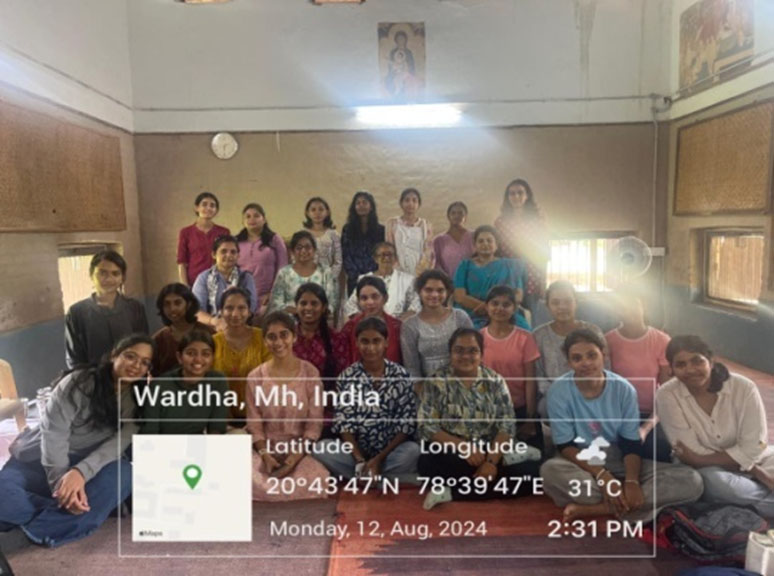
Gandhi Ashram, Sewagram, Wardha
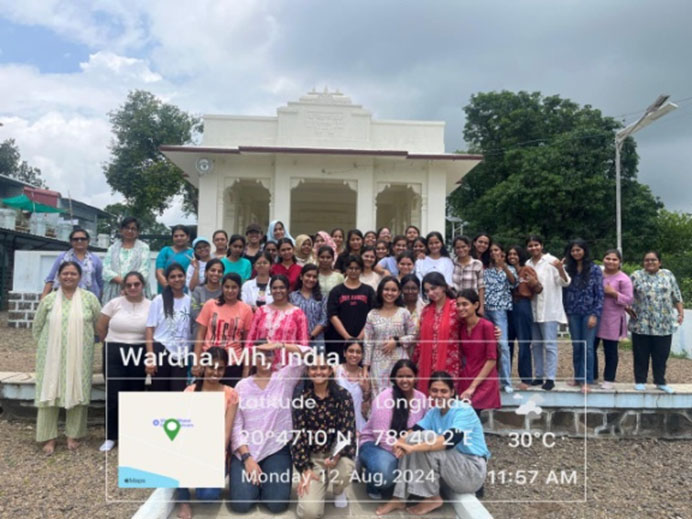
Date: 12/08/2024
Accompanying Faculty:
- Neeta Lambe
- Tarika Dagadkar
- Sarika Joshi
- Ar. Sneha Bodhankar
Participants:
30 Students of the 5th Semester, Architecture
Subject: Vernacular Architecture
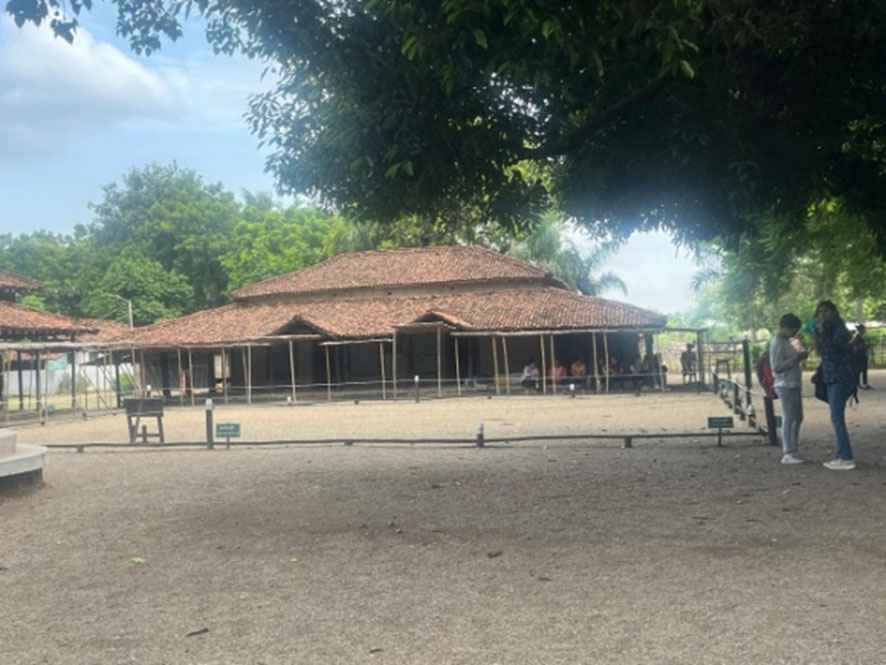
On 12th August 2025, 30 students of the 5th semester, accompanied by four faculty members, visited Gandhi Ashram in Sewagram, Wardha, as part of the Vernacular Architecture. The primary objective of this visit was to document and understand the vernacular architecture specific to the Vidarbha region, which is well-preserved in the Ashram’s buildings.
The purpose of the visit was to provide students with an opportunity to explore and analyze the indigenous architectural styles and techniques that are characteristic of the Vidarbha region. The site visit aimed to complement the theoretical knowledge acquired in the classroom by exposing students to real-world examples of vernacular architecture.
The architecture of the Gandhi Ashram reflects simplicity and functional design, which is emblematic of the Gandhian philosophy. The structures are primarily built using locally available materials such as mud, stone, and bamboo, showcasing the sustainable practices inherent in vernacular architecture.
The buildings predominantly use adobe walls, thatched roofs, and earthen floors. The use of these materials not only aligns with the climatic conditions of the region but also contributes to the sustainability and low environmental impact of the structures.
Traditional construction techniques, such as wattle and daub, are evident in the walls, providing excellent insulation and thermal comfort. The layout of the buildings is designed to optimize natural ventilation and lighting, reducing the need for artificial cooling and lighting.
The Ashram’s architecture is deeply rooted in the cultural and social context of the region. The design and layout of the spaces reflect the communal and self-sufficient lifestyle promoted by Mahatma Gandhi, emphasizing the importance of harmony with nature.
The spatial arrangement of the Ashram buildings reflects a blend of private and communal spaces, which are interconnected by open courtyards and pathways. This layout not only facilitates interaction but also enhances the sense of community among the inhabitants.
The students actively engaged in documenting the architectural details through sketches, photographs, and notes. They were encouraged to observe the relationship between the built environment and the natural landscape, as well as the functional aspects of the design.
The visit to Gandhi Ashram provided the students with a profound understanding of vernacular architecture in the Vidarbha region. It allowed them to witness first-hand how traditional building practices are adapted to local climatic conditions and cultural contexts. This experience will undoubtedly enrich their academic journey and inspire them to incorporate sustainable and contextually relevant practices in their future architectural endeavours.
NaiTalim School, Gandhi Ashram, Sewagram, Wardha
Subject: Institutional Project (3rd Semester)
Date: 12/08/2024
Total Participants/ Beneficiaries: 55 students, 4 teachers
Teacher In charge: Dr. Neeta Lambe, Dr. Tarika Dagadkar, Ar. Sneha Bodhankar, Ar. Sarika Joshi
Objective of visit: To develop understanding about the importance of historical and heritage buildings and to provide knowledge about the various indigenous vernacular construction in architecture.
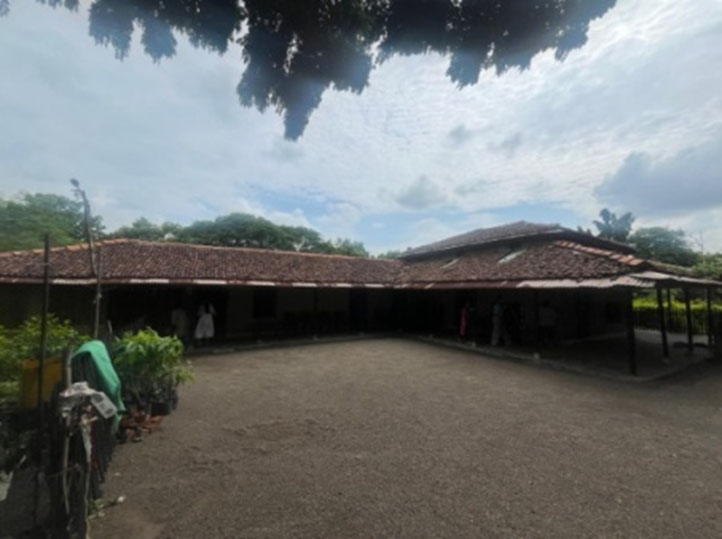
On 12 th August 2024, SMMCA INTACH Heritage Club organized visit to the Old High Court Building in Nagpur, for 3rd sem. students of Institutional Project elective, with the goal of documenting and understanding the unique architectural design of the school, which is deeply rooted in the principles of experiential learning and sustainable practices. 30 students of the 3rd semester, along with four faculty members, visited Nayi Talim School in Sewagram, Wardha. The visit was organized as part of the.The primary purpose of the visit was to enable students to explore the architectural aspects of an institution that is historically and culturally significant. The students were tasked with documenting the spatial organization, construction techniques, material use, and the overall design philosophy of the Nai Talim School.
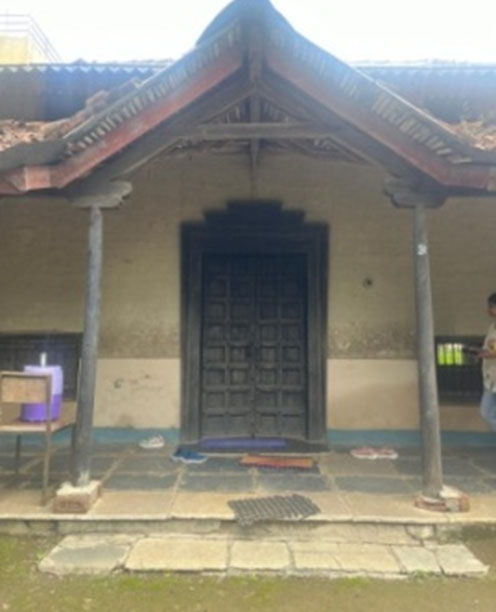
The students were actively involved in documenting the architectural features of the school. They sketched floor plans, elevations, and sections, and took detailed notes on the construction techniques and materials used. The visit also provided them with an opportunity to understand how architectural design can reflect and support educational philosophies.
The visit to Nai Talim School offered the students a comprehensive understanding of how architecture can be used to create educational environments that are sustainable, functional, and culturally relevant. The insights gained from this visit will be invaluable as they continue their studies in institutional architecture and design.
Visited Bajaj Institute of technologies (BITs), with an objective of site planning and campus. Understanding the placement of activities as per circulation and climate responsive design which was designed by master Ar. Christofer Beninger
Documentation of Nai Talim, Sewagram, Wardha and Chandrapur Fort Pricinct
In this session, Documentation of the Nai Talim School documentation was carried out. Students of 3rd semester 2024-25 visited the Sewagram Ashram for a days and took the measurements on-site in the form of field notes. After returning, students then prepared the complete measured drawing of the same and this documentation was sent to INTACH Heritage competition 2025 and coordinated Documentation of Chandrapur Fort Pricinct for COA Heritage Awards 2025 done by 1st year students batch 2024-25.
Start your inspired journey
with SMMCA
About SMMCA
Smt Manoramabai Mundle College of Architecture offers a five year degree course in Architecture (B.Arch), two year post graduate course (M.Arch in Architecture Education and Urban Planning) and Ph.D. in architecture.
Follow Us
Contact Us
Address
SMT. MANORAMABAI MUNDLE COLLEGE OF ARCHITECTURE LAD COLLEGE CAMPUS, SEMINARY HILLS, NAGPUR 440006 (M.S.) INDIA
Copyrights © 2025. All rights reserved by SMMCA, Nagpur.